Every time your foot lands while running, your body absorbs a force several times your own body weight. Understanding what actually happens in that split second — and what the research does and doesn’t tell us about cushioning — helps explain why shoe choice is such a personal, often debated topic among runners.
This article covers general biomechanics concepts for educational purposes and isn’t medical advice. If you’re dealing with pain or a specific injury concern, it’s worth speaking to a physiotherapist or podiatrist rather than relying on shoe choice alone.
What Actually Happens When Your Foot Hits the Ground
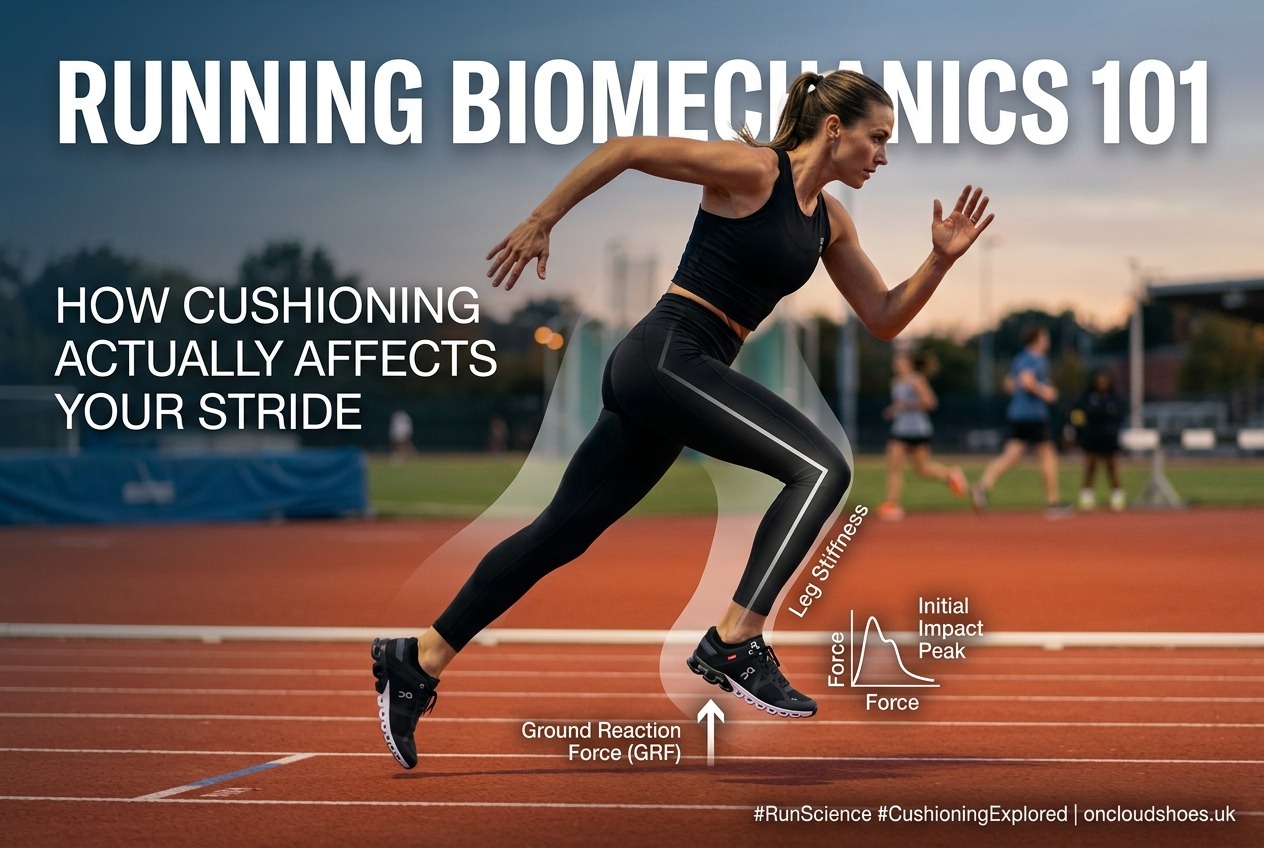
Scientists measure this moment through something called ground reaction force (GRF) — essentially, Newton’s third law in action. As your foot pushes down into the ground, the ground pushes back with equal force. This force typically peaks at two to three times a runner’s body weight, and how quickly that force builds up is referred to as the loading rate.
Where Cushioning Was Assumed to Help — and Where the Evidence Gets Complicated
For decades, the working assumption in running shoe design was straightforward: more cushioning means less impact force, which means lower injury risk. The actual research tells a messier story.
A study published in the Journal of Applied Physiology documented what researchers call the “impact force anomaly” — the observation that shoe cushioning often fails to meaningfully reduce the early, sharp impact peak a runner’s leg experiences, even in well-cushioned shoes. Separately, research published in Scientific Reports found that running in highly cushioned shoes can actually increase leg stiffness and amplify impact loading, as runners subconsciously adjust their stride to compensate for the extra padding underfoot.
On top of that, ground reaction force itself has a more complicated relationship with injury than commonly assumed. A 2024 systematic review in Frontiers in Bioengineering and Biotechnology found only a marginal, inconsistent link between GRF and actual tissue-level loading on bones like the tibia — meaning a higher force reading on a lab sensor doesn’t necessarily translate directly into higher injury risk for every runner.
So Does Cushioning Matter at All?
Yes, but probably not in the simple “more equals safer” way it’s often marketed. A large randomized trial involving over 800 recreational runners, published in Frontiers in Sports and Active Living, found that a softer shoe version was associated with lower injury risk in that study group — though the same research noted the relationship between force characteristics and injury was more nuanced than a straightforward cause-and-effect. Other studies, including systematic reviews of footwear construction, have found mixed or inconclusive results depending on runner population and study design. The honest summary from the current body of research is that cushioning affects comfort and how impact force is distributed over time, but its relationship to injury risk varies significantly between individuals, running styles, and training loads.
Why “One Size Fits All” Advice Doesn’t Really Exist
A shoe that reduces impact loading for one runner might change another runner’s stride in a way that increases stress elsewhere in the leg. Foot strike pattern, running speed, body weight, training volume, and individual gait mechanics all interact with a shoe’s cushioning in ways that are still being studied. This is part of why blanket claims — “maximal cushioning prevents injury” or “minimal shoes are safer” — tend to oversimplify a genuinely complex picture.
What This Means Practically
Rather than chasing a specific cushioning level because it’s marketed as injury-proof, most sports science guidance points toward finding a shoe that feels comfortable and stable for your own stride, and adjusting training load gradually rather than relying on footwear alone to manage injury risk. If you’re curious about how different cushioning systems are engineered, our CloudTec® explainer covers the mechanics of one such approach in more detail, purely from a design perspective rather than a health claim.
Frequently Asked Questions
Does more cushioning always mean less impact on your joints?
Not necessarily. Research shows cushioning doesn’t consistently reduce the initial impact peak a runner experiences, and in some cases, highly cushioned shoes can change stride mechanics in ways that offset the padding’s intended effect.
Is ground reaction force the same as injury risk?
No. GRF measures the force between the foot and the ground, not the actual load experienced by internal structures like bones and tendons. Current research shows the relationship between the two is weaker and more inconsistent than often assumed.
Should I choose a shoe based purely on cushioning level?
Comfort and stability for your individual stride tend to matter more than cushioning amount alone. If you have ongoing pain or a specific injury concern, a physiotherapist or podiatrist can assess your gait far more accurately than general guidance can.
Does foot strike pattern (heel vs forefoot) matter more than cushioning?
It’s one of several contributing factors, but research in this area remains mixed and debated. No single variable, including strike pattern or cushioning, has been shown to reliably predict injury risk on its own.
Explore the Range
Curious how different On Cloud models are cushioned? Browse our full On Cloud shoes UK collection to compare options.